
Lakota Wisdom
/The Lakota Nation are people who were indigenous to the land we know today as Minnesota, Wisconsin, North and South Dakota, Nebraska, Montana, and Canada. There are two teachings from Lakota wisdom I want us to ponder this week: Winter Count and Mitákuye Oyás’iŋ
Winter Count is a graphic depiction of the history of a community.
Each year-end (a year was marked winter to winter) an elder historian of the community would select one image to draw onto a piece of leather buffalo hide that represents the greatest event of the year within the community. Here is a photo of a Winter Count (with dates likely added later) from the Sioux Indian Museum in Rapid City, South Dakota.
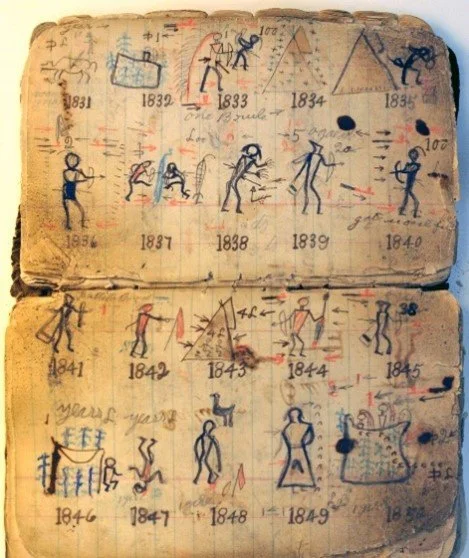
Today, we can honor this Lakota tradition by giving some thought to their method of capturing history. We might think of it today in terms of our marriages and partnerships, how would we depict each year of our relationship? We could also consider the lives of our children, how would each year of their life be represented by a single image?
In reflecting on your own life, what image would capture each year you have lived and the major events of those years?
As you and I consider this exercise, we quickly see that a year is a lot to sum up in one image. And imagine trying to capture it for an entire community. Our pause today to consider this practice helps us remember that we live a lot of life each year. We also have a lot of life ahead in this new year. This can be an exercise of reflection or intention setting. What image would you intend to represent your year ahead? Maybe this year, it isn’t a word of the year, but more of an image.
This wisdom from the Lakota tribe is on my mind as I’ve been researching North American Indigenous Spirituality for an online class I’m leading on the most compassionate teachings of ten world religions. The class starts this week, and it is never too late to join. The teachings are all recorded to watch at anytime. If you would like to participate in the discussions, you can join live Monday and Friday mornings at 10 CST. You can read more about it at CompassionFixCommunity.com. Building our awareness and understanding of the varied human experiences on our planet helps us become more compassionate, less uncomfortable of the unknown, and realize how much we all have in common. Different hallways leading to the same room, different lanterns carrying the same light. As a Christian, studying the compassion teachings from other faiths has deepened my understanding of the teachings of Jesus. If this resonates with you, join us online as we learn, practice, explore, and expand together.
The Lakota people were known to open and close their morning and evening prayers with the words: Mitákuye Oyás’iŋ.
This translates into English as “we are related” and “we are relatives, all.” The Lakota teaching first originated from Ptesanwin, also known as White Buffalo Calf Woman, an elder revered spiritual leader within the Lakota Nation. Her original teaching was an invitation to see the family relationship between humans, animals, plants, rivers, mountains, plains, sun, moon, and stars. She spoke of an interconnectedness of all of creation and our duty to revere and care for it all.
This is sage and timeless wisdom from Ptesanwin for us today. What would our days be like if we saw everyone and everything as “we are related” to one another? What would it feel like to see others with the same love for which we see our friends and families? How would we feel in nature if we saw the trees, the water, the birds, and the sun as relatives?
We are all humans trying to figure out what it means to be human.
World religions are evidence that we are all searching for meaning and divine connection around the globe. In every religion I have studied thus far, love is the foundational teaching. Love in the form of kindness, reverence, mercy, generosity, care for other, respect, divinity, grace, and peace. Love is a synonym for all of those things. We are all humans looking for words to describe something bigger than all of our vocabularies. It’s all love. And it always has been.
We are all related,
